


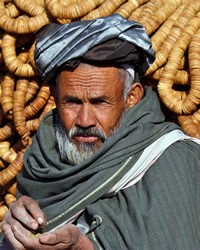

The Pashtun of Afghanistan and Pakistan have been called the largest Muslim tribal society in the world. They were the rulers of Afghanistan for over 250 years and still have much power through the Taliban. There are at least 30 major tribes, and countless sub-tribes and clans. Each clan can be friendly or hostile towards members of another particular clan, adding more divisions.
Pashtuns share a unique sense of common identity. Pashtun identity is based on four elements: Heritage (descent from a common ancestor); Islam, the Pashtunwali Code of Honor ("The Way of the Pashtun"); and to some extent, Language (Pakhtu or Pashto). Their common culture is what binds the Pashtun people together. More significant than dialectical differences, a Pashtun's primary loyalty is to his particular social group (tribe or sub-tribe).
However, different languages pose communication differences. Southern Pashto speakers live primarily in Afghanistan and Pakistan, though there is a significant Pashtun diaspora in the Arab Gulf and many Western countries. Those who speak the Southern Pashtun language live in a total of 13 countries including the Netherlands. Afghan refugees, often Southern Pashtuns, arrived in the Netherlands in multiple waves since the late 1980s, largely settling through asylum or family reunification paths.
Family structures tend to be extended, frequently spread across countries. Multi-generational households reflect traditional Afghan living arrangements.
Reuniting family remains a core aspiration, governed by Dutch asylum and residence regulations that can delay or complicate reunifications.
A study from 2022 emphasizes that newcomers' integration experiences are deeply connected across housing, work, social networks, and language acquisition, showing mutual interaction among all domains.
Afghan-Pashtun organizations—like Uvavin (Union of Afghan Associations in Holland) and MCAN (Medical City Amsterdam Network)—offer social and cultural programs, including adult education in Dari and Pashto, community outreach, and support.
Cultural preservation occurs through gatherings, Pashto language classes, shared meals, and raising awareness of Pashtun traditions rooted in Pashtunwali, like hospitality and community responsibility.
Online platforms (e.g., TikTok) reflect cross-cultural celebrations of Pashtun heritage alongside other Afghan groups in the Netherlands.
Southern Pashtuns are solidly Sunni Muslim. However, their devotion to Islam sometimes gets overshadowed by their belief in Pashtunwali, their tribal moral code.
Employment outcomes are often subdued: non-EU migrants, including Afghans, are frequently in temporary roles, part-time jobs, or self-employment. Refugee-specific studies show employment is influenced by Dutch language skills, credential recognition, social capital, health, and time in reception centers—factors that collectively delay economic integration.
Refugees often lack local qualifications, face health issues, and spend extended periods in asylum centers—factors linked to slower job market entry and lower occupational status.
Legal/integration policies: Temporary statuses and limited early work rights (e.g., exemptions to 24-week limits) complicate smooth workforce entry—though recent legal adjustments now allow asylum applicants to work beyond 24 weeks.
Afghan refugees report having to work harder to navigate educational systems and workplace norms in the Netherlands, due to differences in cultural expectations.
Disrupted by conflict and limited visa channels, many Southern Pashtun families live in a transnational, fragmented state—keeping strong kinship ties despite long distances and ongoing uncertainty.
Pray for the production and distribution of all forms of media in the Pashto language, including literature, videos, music, movies, radio, websites, and social media.
Pray for accuracy in the Bible translations in progress.
Pray for more workers to serve the Southern Pashtun people—in education, business, healthcare, development and other professional areas.
Pray for God's Spirit to strengthen and protect new believers and to empower their lives and witness.
Pray for Pashtun religious and family leaders to have dreams of the only Savior, drawing them to truth and righteousness.
Scripture Prayers for the Pashtun, Southern in Netherlands.
References
| Profile Source: Joshua Project |
| Other PDF Profile |


